

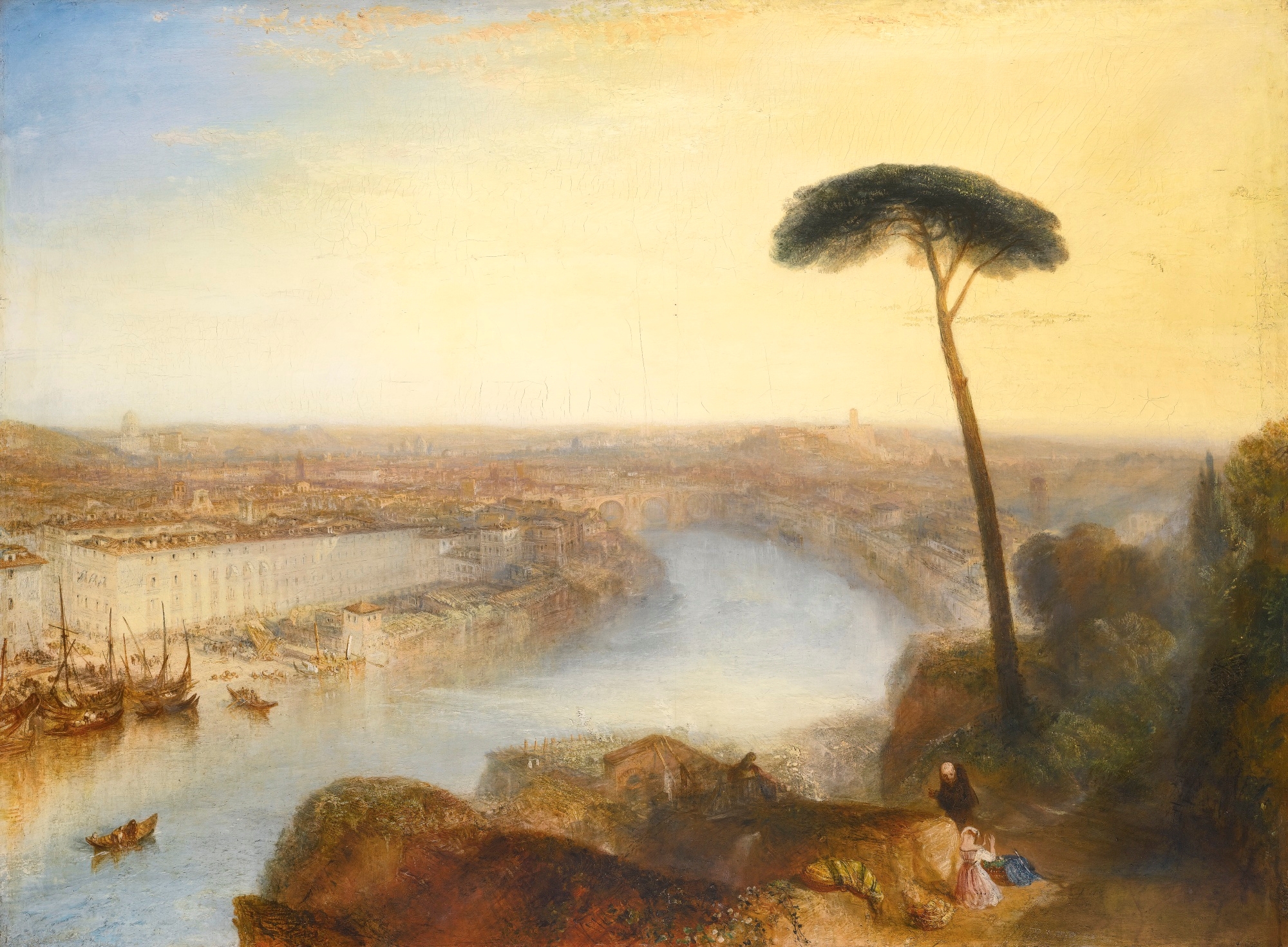
J.M.W. Turner’s Rome, from Mount Aventine could become the most expensive Turner ever sold at auction
Nearly two centuries after J.M.W. Turner painted his celebrated vision of Rome, one of his greatest landscapes has returned briefly to the city that inspired it.
Rome, from Mount Aventine, painted in 1836, was unveiled at Rome’s historic Palazzo Rondinini at the end of September for a rare three-day public presentation. The painting will now travel to Hong Kong and New York before returning to London, where Sotheby’s will offer it for sale on December 9, 2026. The auction house expects it to fetch around £50 million, potentially establishing a new auction record for Turner.
The return to Rome is particularly remarkable because, although the painting was inspired by the Eternal City, it has never previously been exhibited there. It is one of the few major Turner paintings still in private hands.
Turner and the Eternal City
Rome occupied a special place in Turner’s imagination.
The artist first visited Italy in 1819, but it was his later journeys to Rome that had a profound effect on his work. During his second Italian trip in the late 1820s, Turner made numerous sketches of the city and its ancient monuments.
Rome, from Mount Aventine was ultimately completed in London and exhibited at the Royal Academy in 1836. The painting transforms Turner’s observations of Rome into an extraordinarily luminous panorama.
From the elevated viewpoint of the Aventine Hill, the viewer looks across the Tiber toward the city. The ancient Ponte Emilio appears in the foreground, while the distant skyline includes some of Rome’s most recognizable landmarks. (AP News)
But Turner was not attempting to create a precise architectural record.
His Rome is an atmosphere.
The city appears through a golden haze, with the light of early morning spreading across the landscape. The river catches the light, while the buildings and monuments gradually dissolve into the distance.
The effect is remarkably modern.
A painting about light
Turner is often regarded as one of the great pioneers of modern landscape painting because he increasingly treated light and atmosphere as subjects in their own right.
In Rome, from Mount Aventine, architecture remains important, but it is almost overwhelmed by the changing effects of light.
The warm sky, pale blue distance and shimmering river create an impression of a city seen at a particular moment rather than a permanent view.
Turner’s technique contributes to this effect. The painting combines traditional oil painting with remarkably experimental handling of the medium. Sotheby’s notes the use of palette knives and the artist’s fingers, as well as passages in which oil paint was manipulated to produce effects resembling watercolor.
An extraordinary state of preservation
Perhaps the most remarkable aspect of the painting today is not only its beauty but its physical condition.
The canvas remains unlined and unrestored, preserving details that are rarely visible in paintings nearly two centuries old. Turner’s fingerprints and traces of his working process can still be seen in the paint, along with even individual hairs from a brush that became trapped in the surface.
For art historians and collectors, this makes the work unusually valuable as evidence of Turner’s technique.
It is almost possible to see the artist’s hand at work.
A remarkable history
The painting was originally commissioned by Turner’s important patron Hugh Andrew Johnstone Munro of Novar.
It later entered the collection of Archibald Primrose, 5th Earl of Rosebery, who served as British prime minister in the 1890s, and his wife, Hannah de Rothschild. The work remained within the Rosebery family for more than a century.
When it was sold by Sotheby’s in December 2014, it achieved £30.3 million, establishing Turner’s current auction record.
Now the same painting is returning to the market.
Sotheby’s has placed an estimate of approximately £50 million on the work. If it reaches that figure, it would comfortably exceed the previous record established by the painting itself in 2014.
Could Turner break his own record?
The art market has changed considerably since 2014, but a £50 million estimate places the painting among the most important Old Master and 19th-century works coming to auction this year.
There is also a special attraction for collectors: major Turners of this quality are exceptionally rare on the open market.
The painting’s previous auction history makes the forthcoming sale even more unusual. It is not an unknown work suddenly emerging from a forgotten collection. It is a recognized masterpiece returning to the market after more than a decade.
And its condition may prove particularly important.
For museums and collectors, an original, unrestored Turner offers something that money cannot easily reproduce: an unusually direct connection with the artist’s working process.
From Rome to the modern world
Turner’s importance extends far beyond British landscape painting.
His experiments with light, color, atmosphere and almost abstract forms anticipated developments that would emerge decades later in Impressionism and modern art. Even before Monet and the other Impressionists began exploring the changing appearance of nature, Turner was already pushing landscape painting toward a world in which recognizable objects could dissolve into light and color.
That is particularly visible in Rome, from Mount Aventine.
The painting contains ancient Rome, but it does not feel like an antiquarian document. It feels alive, changing from one second to the next.
Perhaps that is why the work can still look surprisingly contemporary nearly 200 years after it was painted.
A brief homecoming
Turner’s return to Rome is therefore more than a promotional stop before an auction.
For three days, a painting conceived in Italy almost two centuries ago was finally shown in the city it depicts.
It then continues its journey through the international art market — from Rome to Hong Kong and New York, and finally to London for the December auction.
Whether it reaches £50 million or goes even higher, Rome, from Mount Aventine has already achieved something extraordinary.
After almost two centuries, Turner’s vision of Rome has finally come home.

Leave a Reply