

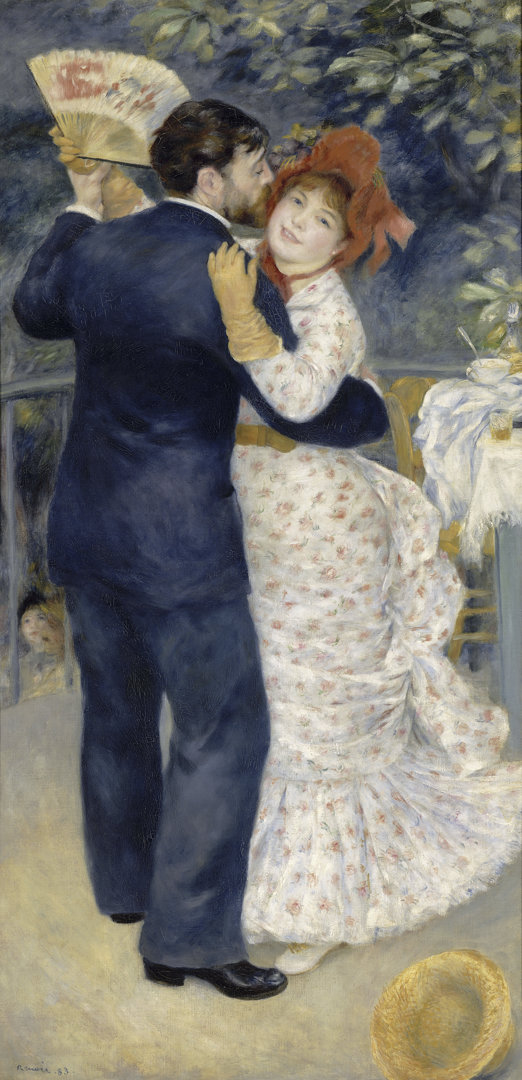
A major Musée d’Orsay exhibition presented Renoir not simply as the painter of beautiful scenes, but as one of the most inventive chroniclers of modern life
For generations, Pierre-Auguste Renoir has been associated with a particular image of Impressionism: sunlit gardens, elegant women, outdoor dances, charming portraits and moments of carefree pleasure. His paintings are among the most recognizable images in Western art.
Yet familiarity can sometimes work against an artist. Reproduced endlessly on posters, postcards and decorative objects, Renoir’s paintings have become so deeply embedded in popular culture that their original radicalism can be difficult to see.
A major exhibition at Paris’s Musée d’Orsay, Renoir and Love: A Joyful Modernity (1865–1885), invited visitors to look at the artist again — and to reconsider what made his paintings so modern in the first place. The exhibition ran from March 17 to July 19, 2026, and was organized around the crucial years in which Renoir helped develop Impressionism.
Beyond the “painter of happiness”
Renoir has sometimes been dismissed as a painter of superficial happiness: beautiful people enjoying themselves in beautiful surroundings.
The Musée d’Orsay exhibition challenged that simplified view.
During the 1860s and 1870s, depicting happiness and intimacy in contemporary life was itself a surprisingly modern artistic choice. Renoir turned his attention away from the grand historical and mythological subjects traditionally favored by the academic establishment and toward people as they actually lived — meeting friends, dining, dancing, walking, flirting and spending time outdoors.
His world included cafés, restaurants, gardens, theaters, boulevards and guinguettes, the popular outdoor dance venues that became important settings for Impressionist painting.
The exhibition therefore presented love not simply as a romantic subject, but as a way of understanding Renoir’s entire approach to painting. Human relationships — between couples, friends, families and strangers — became opportunities to explore gesture, color, proximity and movement.
The early Renoir: searching for a new language
One of the most fascinating aspects of Renoir’s career is that he did not arrive at his mature style fully formed.
His early work shows an artist searching.
Renoir began his career within the traditions of academic painting, studying at the École des Beaux-Arts and copying the Old Masters at the Louvre. But during the 1860s he increasingly encountered artists who were questioning the established rules of painting.
His friendship with Claude Monet, Alfred Sisley, Frédéric Bazille and other young painters proved particularly important.
Together, they explored the effects of natural light and experimented with painting contemporary subjects directly from life. Instead of constructing idealized scenes in the studio, they wanted to capture the changing appearance of the world around them.
Renoir’s brushwork became lighter and more fluid, while his palette became increasingly vibrant.
The result was not merely a new technique. It was a new way of looking.
La Promenade: intimacy in the landscape
One of the works associated with this period is La Promenade of 1870.
A young woman and a small child move through a leafy landscape, surrounded by dense vegetation and dappled light. At first glance, it appears to be a simple outdoor scene. But Renoir’s treatment of the figures and foliage already demonstrates his interest in the relationship between people and their surroundings.
The painting also reveals something that would remain important throughout his career: Renoir was interested in human presence as much as landscape.
Nature is not an empty background. It surrounds the figures, frames them and becomes part of the emotional atmosphere of the scene.
The Musée d’Orsay selected La Promenade as one of the key images for the exhibition.
Bal du moulin de la Galette: the city comes alive
Few paintings illustrate Renoir’s vision of modern Paris better than Bal du moulin de la Galette, painted in 1876.
The famous scene shows Parisians enjoying an afternoon at the Montmartre dance hall. There is no heroic narrative and no dramatic historical event. Instead, Renoir gives importance to something apparently ordinary: people enjoying one another’s company.
But the composition is remarkably ambitious.
Figures overlap, turn toward one another and disappear into the crowd. Sunlight filters through the trees, creating constantly changing patches of light and shadow across clothing, faces and tables.
The painting is almost cinematic in its sense of movement.
This is one reason Renoir’s Impressionism was revolutionary. He was showing contemporary life not from a distance, but from inside it.
The Musée d’Orsay’s own version of Bal du moulin de la Galette was later sent to London for the continuation of the exhibition, where it was displayed at the National Gallery for the first time in Britain.
Love, friendship and everyday encounters
The exhibition also emphasized something particularly characteristic of Renoir: his fascination with relationships.
More than a third of the canvases he produced during the two decades covered by the exhibition involve scenes of modern love and social interaction. These include couples, friends, conversations, flirtation, family life and moments of companionship.
Renoir’s couples are rarely presented as isolated romantic symbols. They belong to a larger social world.
A woman might be talking to a man at a café. Friends might share a meal. A couple might dance in a crowded room. Children might appear beside adults in a garden.
This gives his paintings an unusual sense of warmth and immediacy.
Rather than treating love as a grand dramatic subject, Renoir found it in ordinary human contact.
The famous light — and what lies beneath it
It is easy to look at a Renoir and see only color.
Pink dresses, green leaves, blue shadows, golden sunlight and flashes of white create the instantly recognizable appearance of his Impressionist paintings.
But beneath that apparent spontaneity was considerable experimentation and preparation.
This became especially clear through another exhibition presented at the Musée d’Orsay at the same time: Renoir Drawings, the first major exhibition devoted specifically to his works on paper. It demonstrated how important drawing remained to Renoir, despite the popular image of Impressionists as artists who simply painted rapidly in front of nature.
Renoir continued to draw throughout his life. His drawings included preparatory studies, portraits, watercolors, pastels and sketches for larger compositions.
They reveal an artist much more deliberate than the spontaneous Impressionist stereotype might suggest.
When Renoir changed direction
The story does not end with Impressionism.
During the 1880s, Renoir began to question the direction in which Impressionist painting was developing. He became increasingly interested in drawing, structure and the traditions of earlier European painting.
His figures became more solid and sculptural. The loose brushwork and fragmented light of his earlier paintings gave way, in many works, to more clearly modeled bodies and stronger contours.
This transformation has sometimes been described as a retreat from Impressionism.
But it can also be understood as another stage in Renoir’s continual search for a new artistic language.
The contrast is one of the most interesting elements of his career: the same painter who could dissolve a Parisian scene into flickering patches of sunlight could later become deeply interested in the monumental human figure.
Why Renoir still matters
The Paris exhibition offered an opportunity to reconsider an artist who is perhaps too familiar.
Renoir’s paintings can seem effortless because they are so visually inviting. But behind the pleasure of his pictures lies a serious artistic proposition: modern life itself could be beautiful, and ordinary human relationships could be worthy of great painting.
At a time when much modern art was increasingly associated with anxiety, alienation and conflict, Renoir insisted on looking at another side of modern existence.
His cafés, gardens, dances and lunches are not simply escapist fantasies. They record a society discovering new forms of leisure, sociability and personal freedom.
That may be why Renoir’s paintings continue to attract audiences more than a century later.
His world is filled with sunlight, movement, friendship and human contact — and his greatest paintings transform these apparently simple pleasures into something much more lasting.
The Paris exhibition may now be over, but its reassessment of Renoir continues in London, where Renoir and Love opened at the National Gallery on October 3, 2026, before traveling to Boston in 2027.

Leave a Reply