

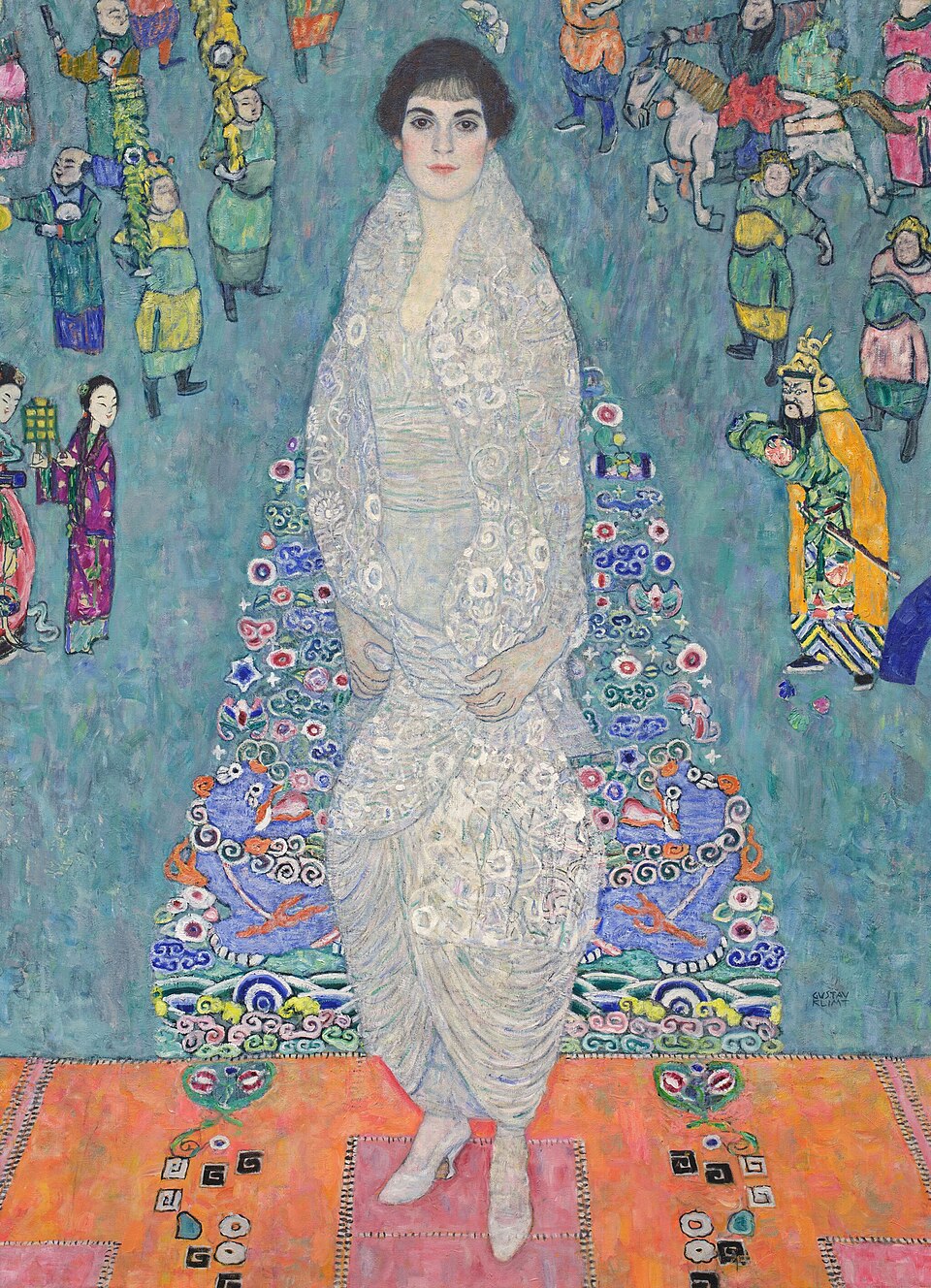
Gustav Klimt’s enigmatic Portrait of Elisabeth Lederer, painted between 1914 and 1916 and long concealed from public view, has emerged as a defining monument in the history of modern art, fetching an extraordinary $236.4 million at Sotheby’s and securing its place as the most expensive work ever sold by the artist. The painting was commissioned by the Lederers, one of Vienna’s wealthiest and most culturally engaged Jewish families, whose patronage was instrumental in shaping Klimt’s later work, allowing him to explore new depths of psychological intensity, symbolic complexity, and innovative compositional strategies. August and Serena Lederer were not mere collectors; they were connoisseurs who recognized the audacity of Klimt’s vision and encouraged him to create portraits that transcended simple likeness, blending intimate observation with mythic resonance, allegory, and hidden geometric order. Their support enabled him to experiment with forms that were simultaneously modern and esoteric, weaving together motifs drawn from East Asian art, symbolic abstraction, and subtle visual references to concepts of life, lineage, and the hidden architecture of the natural world.
Confiscated by the Nazis during the Anschluss in 1938, the portrait disappeared from public view for decades, only resurfacing in the 1980s and eventually entering private hands before returning to public attention in 2025, when it was sold for its record-breaking price. Unlike Klimt’s Golden Period works, in which gold leaf and decorative splendor dominate, the Lederer portrait achieves a more psychologically charged brilliance through color, texture, and ornamentation: shimmering whites, luminous blues, and meticulously detailed motifs convey an intensity that seems almost alive, pulsing with symbolic resonance. The flowing white silk gown in which Elisabeth is depicted unfurls like a cocoon, echoing the recurring motif of the chrysalis and butterfly in Klimt’s late work, a metaphor for transformation, emergence, and renewal. Across the surface, dragons inspired by Qing dynasty textiles coil around her legs, suggesting cosmic authority and mythic power, while abstract ovals, concentric circles, and biomorphic shapes embedded in the fabrics evoke ideas of lineage, identity, and unseen structures of life itself, forming a visual language that is both personal and universal. These layers gain uncanny significance considering Elisabeth’s later life: in the face of rising Nazi persecution, she and her mother claimed, falsely, that Klimt was her biological father, a narrative that ensured her survival and added a retrospective resonance to the portrait’s quiet exploration of protection, secrecy, and transformation.
Perhaps most striking is the subtle geometric composition underlying the work: an upright triangle is formed by the apex of Elisabeth’s dark hair and the tapering points of her flowing gown, creating a perfect triangular axis that echoes the radiant triangle of Masonic and esoteric symbolism, a sign of enlightenment, hidden knowledge, and the convergence of material and spiritual realities. Klimt’s integration of this geometric principle reflects both his immersion in Vienna’s avant-garde intellectual circles and the influence of his Jewish patrons, whose encouragement enabled him to pursue art that was simultaneously radical, intellectual, and infused with subtle codes of meaning. The triangle is neither accidental nor decorative alone; it frames Elisabeth as a figure poised between revelation and mystery, human and mythic, mortal and timeless. Beyond the geometry, the portrait operates on multiple symbolic levels: it is a tribute to the vision and support of the Lederer family, a meditation on youth, beauty, and identity, a visual synthesis of myth, science, and esoteric philosophy, and a testament to resilience in the face of historical violence. Every element of the painting—the iridescent folds of the gown, the carefully placed dragons, the biomorphic motifs, and the overarching triangular structure—works together to create a sense of balance, hidden order, and spiritual resonance, suggesting that Elisabeth herself is a guardian of secrets, a participant in a continuum of knowledge that spans both earthly and cosmic domains. Klimt’s late work, far from decorative indulgence, demonstrates mastery of subtle symbolism and layered meaning, where the influence of enlightened, culturally sophisticated Jewish patrons intersects with the artist’s fascination with life, metamorphosis, and geometric and mystical order. Viewed in its totality, Elisabeth appears suspended between transformation and revelation, her elongated figure and prismatic gown echoing the wings of a butterfly just breaking free from its chrysalis, ready to unfurl into the world.
The staggering auction price may be read as recognition of Klimt’s technical genius, but it also reflects the portrait’s extraordinary capacity to encode mythology, patronage, personal history, and esoteric geometry into a single, mesmerizing tableau. In this way, Portrait of Elisabeth Lederer stands not only as a masterpiece of early twentieth-century art but as a profound meditation on survival, transformation, and the hidden patterns that link human identity to the cosmos, a painting that continues to reveal new meanings as it moves from shadow into light.


Leave a Reply