

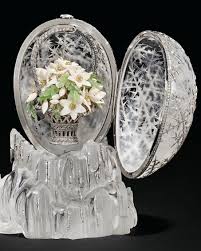
London has always enjoyed a spectacle, and on Tuesday night Christie’s gave it one worthy of the city’s appetite for glitter and drama. The legendary Fabergé Winter Egg — one of the very last imperial eggs still in private hands — sold for an astonishing £22.9 million, easily surpassing the previous Fabergé auction record set in 2007.
Commissioned in 1913 by Tsar Nicholas II as an Easter gift for his mother, the Dowager Empress Maria Feodorovna, the Winter Egg sits at the intersection of imperial history, artistic ambition, and looming tragedy. Only fifty imperial eggs were ever created; barely seven remain in private ownership. Their rarity alone electrifies the market, but the Winter Egg brings something more — theatrical sparkle, exquisite craftsmanship, and the ghostly aura of a vanished world.
Christie’s Head of Fabergé, Margo Oganesian, called the sale “an exceptional and historic opportunity,” and the room felt it. Even among seasoned collectors, the egg carried a strange presence: part jewel, part apparition.
Designed by Alma Theresia Pihl, one of the few women entrusted with major Fabergé commissions, the egg draws on a poetic source — frost patterns forming on her workshop window. The results still look startlingly modern: rock crystal carved like frozen water, platinum snowflakes, and thousands of tiny diamonds that shimmer without overwhelming. As Kieran McCarthy of Wartski put it, the magic lies in turning “precious materials into a moment of nature.” Holding it, he said, is “like holding a lump of ice.”
Yet its journey has been anything but serene. After the Russian Revolution, the egg was swept into the Kremlin Armoury, then sold off by the Soviet government for a fraction of its worth — it appeared in London in the 1920s for just £450. Discreetly bought in 1934, it later vanished for nearly 20 years before reappearing at auctions in 1994 and 2002, each time breaking records before slipping back into silence. Fabergé eggs have a way of disappearing into vaults and resurfacing when least expected.
Christie’s offered the Winter Egg alongside nearly fifty Fabergé pieces from a so-called “princely collection”: jewelled pendants, miniature carvings, gold boxes. A hardstone street painter brought £1.5 million; a rare illustrated catalogue of over 1,000 Fabergé works exceeded £500,000. On any other evening, they would have been the stars. But the Winter Egg gravitates toward the spotlight.
What makes it feel so contemporary is not only its crystalline design but its history of displacement. The egg has passed through empires, revolutions, dealers, and private collectors — neither stolen nor safely housed, simply adrift. A relic always in motion.
Christie’s catalogue reproduces the original invoice: 24,600 rubles, the third-highest sum Fabergé ever charged the Romanovs. A lavish gift offered on the eve of catastrophe — a reminder that even the most extravagant objects double as timestamps.
As for its new owner, Christie’s remained discreet. Whether the egg now rests in a Swiss vault or a private museum in Singapore, no one knows. Fabergé pieces obey their own timelines.
For now, what remains is the image of a century-old imperial treasure gliding once again into the shadows — glittering briefly before disappearing, like frost on glass or history surfacing just long enough to be sold.


Leave a Reply