

Lost Masterpiece of Ancient Greece Recreated in Pompeii
A celebrated sculpture that has been missing for more than two millennia has been brought back to life in Pompeii.
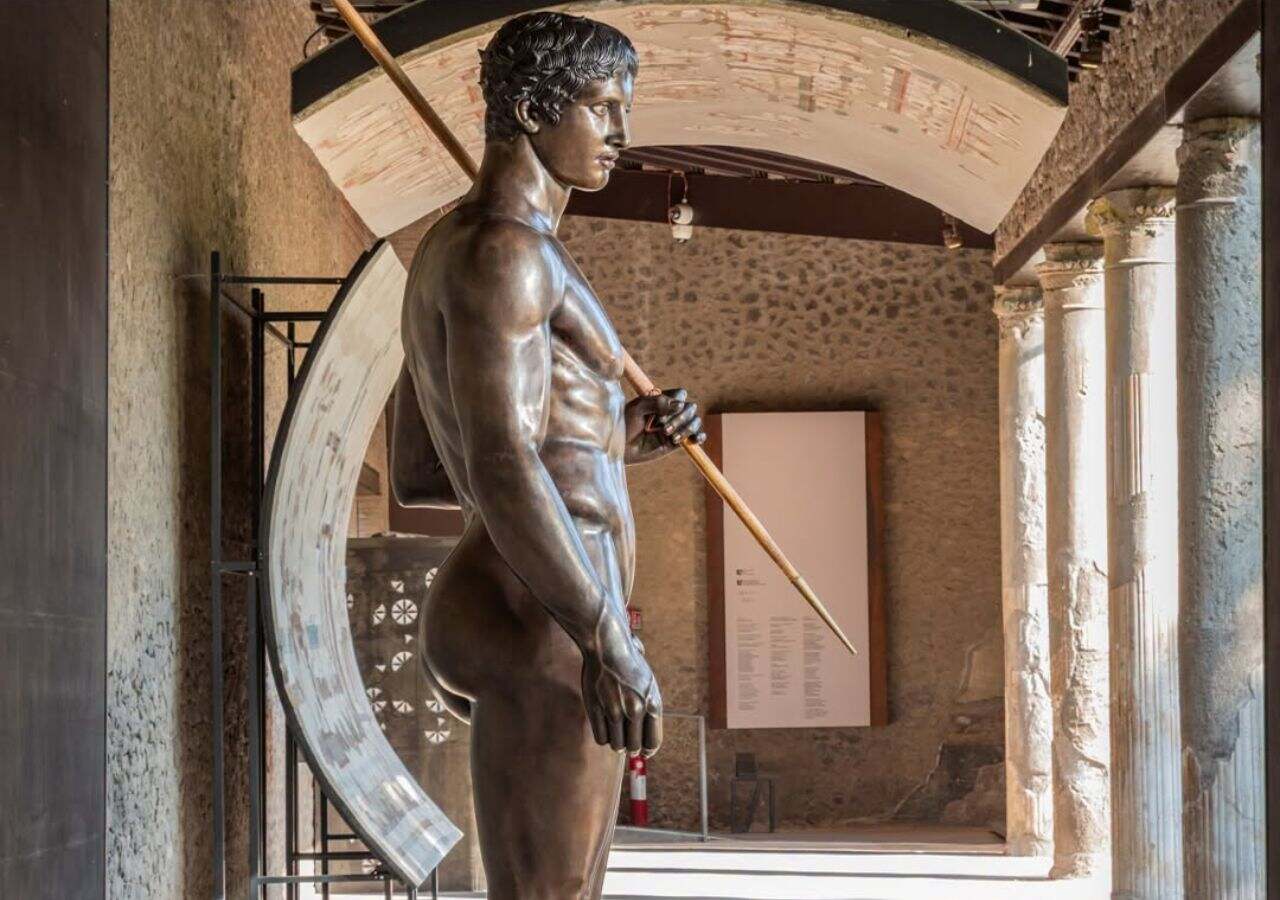
The Archaeological Park of Pompeii has unveiled a new bronze reconstruction of the Canon of Polykleitos, one of the most influential works in the history of Classical Greek art. The sculpture is now displayed inside the Palestra Grande, Pompeii’s largest ancient gymnasium.
Created by the Greek sculptor Polykleitos in the 5th century B.C.E., the original Canon was designed as a visual expression of ideal human proportions. The figure represented a muscular young man whose body was carefully calculated according to the artist’s theories of harmony, balance and proportion.
The original bronze statue has been lost, but its influence survived. Roman artists produced numerous marble copies, allowing later generations to reconstruct at least part of Polykleitos’s revolutionary approach to the human figure. His ideas would eventually influence European artists of the Renaissance and beyond.
Now, more than 2,000 years later, Pompeii has created a new bronze version using archaeological evidence preserved in the region.
The body was modeled primarily on a marble copy of the Canon discovered at Pompeii in the late 19th century. The sculptors used a bronze bust discovered at a villa in nearby Herculaneum as the basis for the head.
The reconstruction was produced using the lost-wax casting technique, a method already employed by ancient Greek and Roman bronze sculptors. A wax model is covered with clay, after which the wax is melted away in a furnace. Molten bronze is then poured into the resulting mold, and the clay shell is removed once the metal has cooled.
The modern craftsmen also looked to antiquity when finishing the sculpture. Rather than leaving the bronze with the monochrome appearance often associated with Classical sculpture today, they incorporated polychromy, adding color to the surface. The body and hair were given dark tones, while the lips received a subtle red accent.
The reconstruction also reflects the changing understanding of the original sculpture.
For many years, scholars assumed that the figure of the Canon carried a spear or javelin. More recent research suggests that this may have resulted from confusion between the Canon and another famous work by Polykleitos, the Doryphoros, or “Spear Bearer.” The new reconstruction therefore does not necessarily reproduce the traditional image of the Canon holding a weapon.
The project is closely connected to Pompeii’s efforts to revive an important part of its own artistic heritage.
In 2022, the Archaeological Park acquired the historic Chiurazzi Foundry, a Neapolitan workshop established in the 19th century and famous for producing reproductions of ancient sculptures. Its collection includes more than 1,000 plaster molds based on artworks from Pompeii and Herculaneum.
For the archaeological park’s director, Gabriel Zuchtriegel, these molds are not simply historical objects. They are part of a living tradition.
The plaster casts are themselves fragile. Left unused, they gradually deteriorate, with the material eventually crumbling into dust. Restoring and using them therefore becomes a way of preserving knowledge as well as physical objects.
The recreation of the Canon demonstrates an unusual approach to archaeological heritage: rather than treating the ancient world as something frozen in the past, Pompeii is using modern craftsmanship and historical research to reconnect contemporary audiences with it.
The original Canon may never return. Its bronze has disappeared somewhere in the long history between Classical Greece and the present.
But its proportions, its influence and its artistic ideas survived.
Now, standing again in the ancient setting of Pompeii, a new bronze figure offers visitors something that is neither the original sculpture nor simply a modern copy. It is an interpretation built from fragments of evidence — a reminder that sometimes art history reconstructs the past not by finding what was lost, but by understanding what remained.

Leave a Reply