

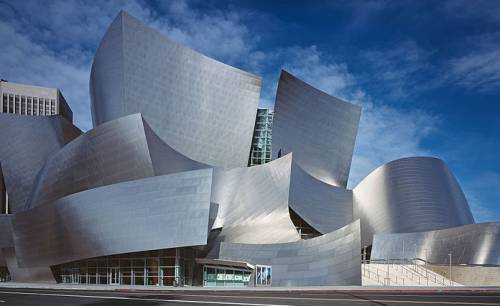
Frank Gehry, the legendary “starchitect” whose radical vision reshaped global architecture and produced some of the most recognisable buildings of the modern age, has died at 96. Born Frank Owen Goldberg in Toronto in 1929, he moved to Los Angeles as a teenager and eventually became one of the most influential designers of the 20th and 21st centuries. Gehry’s rise was anything but traditional: he first gained attention not through museums or skyscrapers, but by transforming his modest Santa Monica home into an explosive collage of raw materials—corrugated metal, chain-link fencing, plywood, angled glass—an audacious gesture that signaled the birth of a design philosophy rejecting conformity and celebrating sculptural freedom. That rebellious spirit soon scaled up to monumental form.
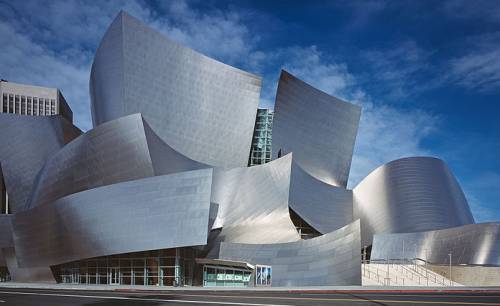
The Guggenheim Museum Bilbao, completed in 1997, was his international breakthrough and remains one of the most revered buildings in the world. With its rippling titanium skin and swirling organic shapes, it redefined what a museum could be and ignited the “Bilbao effect,” a global phenomenon demonstrating the power of architecture to revive a city’s economy and identity. Gehry continued to work at colossal scale, creating the Walt Disney Concert Hall in Los Angeles—an undulating stainless-steel masterpiece praised for both its acoustics and its drama—as well as the Fondation Louis Vuitton in Paris, whose soaring glass “sails” appear to float in the Bois de Boulogne. His portfolio extended across continents: the Dancing House in Prague, the Art Gallery of Ontario renovation in Toronto, the biomorphic Vitra Design Museum in Germany, the striking MIT Stata Center in Cambridge, and dozens of other cultural and academic landmarks.
Throughout his long career, Gehry received architecture’s highest honours, including the Pritzker Prize, the Royal Gold Medal, and the Presidential Medal of Freedom. Yet awards were only one part of his story. His buildings invited debate, sometimes controversy, but always fascination. Critics accused him of indulgence, of prioritising spectacle over practicality, while admirers praised his ability to inject emotion and humanity into steel and stone. Gehry famously dismissed conventions, insisting that architecture should be alive—joyful, surprising, sometimes mischievous. His work embodied that belief, twisting gravity and geometry into forms that felt both futuristic and strangely organic. Even in his later years, Gehry remained active, sketching, modeling, experimenting, constantly pushing the limits of what buildings could express. His death closes a chapter in architectural history defined by ambition, experimentation, and bold imagination. Yet the structures he leaves behind—gleaming, sculptural, impossible to ignore—ensure that his presence will endure for generations, continuing to challenge, provoke, and inspire all who encounter them.




Leave a Reply